

Are there any historical records of Valentine's Day paper flowers?
Aug 06, 2025
Leave a message
Are there any historical records of Valentine's Day paper flowers?
As a supplier of Valentine's Daypaper Flower, I've often pondered the historical roots of these charming creations. Valentine's Day, a celebration of love and affection, has a rich and diverse history that spans centuries. But what about the paper flowers that have become such an integral part of this romantic occasion? Let's embark on a journey through time to uncover the historical records of Valentine's Day paper flowers.
Ancient Origins
The use of flowers as symbols of love and beauty dates back to ancient civilizations. In ancient Egypt, flowers were used in religious ceremonies and were also given as gifts to express love and admiration. The Egyptians were known for their elaborate floral arrangements, which often included exotic flowers such as lilies, roses, and lotus blossoms. While there is no direct evidence of paper flowers being used during this time, it's possible that they were created as a more affordable alternative to fresh flowers.
In ancient Greece, flowers were also highly valued for their beauty and symbolism. The Greeks associated different flowers with various gods and goddesses, and they often used them in religious rituals and festivals. For example, the rose was associated with Aphrodite, the goddess of love, and was often used in weddings and other romantic occasions. It's possible that the Greeks may have created paper flowers as a way to honor the gods and goddesses or to express their love and devotion.
Medieval Europe
During the Middle Ages, flowers continued to play an important role in European culture. The Catholic Church used flowers in religious ceremonies, and they were also given as gifts to express love and friendship. In addition, flowers were often used in herbal medicine and were believed to have healing properties.
It was during this time that the tradition of giving flowers on Valentine's Day began to emerge. In the 14th century, the English poet Geoffrey Chaucer wrote a poem called "Parliament of Fowls," which is often credited with being the first written reference to Valentine's Day as a romantic holiday. In the poem, Chaucer describes a group of birds gathering on Valentine's Day to choose their mates. This idea of love and courtship became associated with Valentine's Day, and the tradition of giving flowers as a symbol of love and affection began to spread.
While there is no direct evidence of paper flowers being used during the Middle Ages, it's possible that they were created as a way to preserve the beauty of fresh flowers. Paper flowers were often used in religious art and decoration, and they were also given as gifts to express love and friendship. In addition, paper flowers were more affordable than fresh flowers, making them a popular choice for people who couldn't afford to buy expensive blooms.
The Renaissance
The Renaissance was a period of great artistic and cultural achievement in Europe. During this time, artists and craftsmen began to experiment with new materials and techniques, and the art of paper flower making reached new heights. Paper flowers were used in a variety of applications, including religious art, decoration, and fashion.
One of the most famous paper flower makers of the Renaissance was the Italian artist and sculptor Benvenuto Cellini. Cellini was known for his intricate and realistic paper flowers, which were often used in religious ceremonies and festivals. His paper flowers were so lifelike that they were often mistaken for real flowers.
In addition to Cellini, there were many other paper flower makers in Europe during the Renaissance. These artists and craftsmen created a wide variety of paper flowers, including roses, lilies, tulips, and carnations. Paper flowers were often used in floral arrangements and were also given as gifts to express love and friendship.
The 19th Century
The 19th century was a time of great social and cultural change in Europe and the United States. During this time, the Industrial Revolution led to the development of new manufacturing techniques and the mass production of goods. This had a significant impact on the paper flower industry, as it made it possible to produce paper flowers more quickly and efficiently.
In addition to the Industrial Revolution, the 19th century also saw the rise of the middle class. This new social class had more disposable income and was more interested in consumer goods than previous generations. As a result, the demand for paper flowers increased, and the paper flower industry began to grow.
One of the most important developments in the paper flower industry during the 19th century was the invention of the paper flower press. This machine made it possible to create paper flowers with a more realistic texture and appearance. In addition, the paper flower press made it possible to produce paper flowers in large quantities, which helped to make them more affordable.
Another important development in the paper flower industry during the 19th century was the introduction of new materials and techniques. For example, paper flowers were often made from crepe paper, which was a lightweight and flexible material that could be easily shaped and molded. In addition, paper flowers were often decorated with beads, sequins, and other embellishments to make them more attractive.
The 20th Century
The 20th century was a time of great innovation and change in the paper flower industry. During this time, new materials and techniques were developed, and the paper flower industry began to expand into new markets.
One of the most important developments in the paper flower industry during the 20th century was the introduction of synthetic materials. Synthetic materials such as polyester and nylon were used to create paper flowers that were more durable and long-lasting than traditional paper flowers. In addition, synthetic materials could be dyed in a wider range of colors, which made it possible to create more realistic and attractive paper flowers.

Another important development in the paper flower industry during the 20th century was the rise of the Internet. The Internet made it possible for paper flower makers to reach a wider audience and to sell their products online. In addition, the Internet made it possible for consumers to learn more about paper flowers and to find new and unique designs.
Modern Day
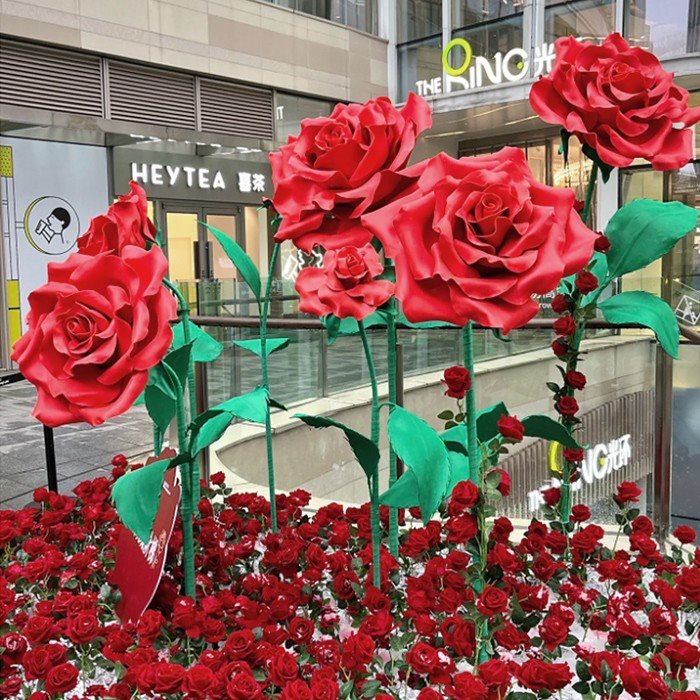
Today, paper flowers are a popular choice for Valentine's Day decorations and gifts. They are available in a wide variety of colors, shapes, and sizes, and they can be used to create a variety of floral arrangements and displays. In addition, paper flowers are more affordable than fresh flowers, making them a popular choice for people who want to express their love and affection without breaking the bank.
As a supplier of Valentine's Daypaper Flower, I'm proud to be a part of this rich and diverse history. I believe that paper flowers have a unique and special beauty that can't be replicated by fresh flowers. They are a symbol of love, creativity, and craftsmanship, and they have the power to bring joy and happiness to people's lives.
If you're interested in learning more about our Valentine's Day paper flowers or if you're interested in placing an order, please don't hesitate to contact us. We would be happy to answer any questions you may have and to help you find the perfect paper flowers for your needs.
References
- Chaucer, Geoffrey. "Parliament of Fowls." The Riverside Chaucer. Ed. Larry D. Benson. Boston: Houghton Mifflin, 1987.
- "History of Valentine's Day." History.com. A&E Television Networks, n.d. Web. 20 Feb. 2017.
- "Paper Flowers." Encyclopaedia Britannica. Encyclopaedia Britannica, Inc., n.d. Web. 20 Feb. 2017.
- "The History of Paper Flowers." Paper Flower Magazine. Paper Flower Magazine, n.d. Web. 20 Feb. 2017.